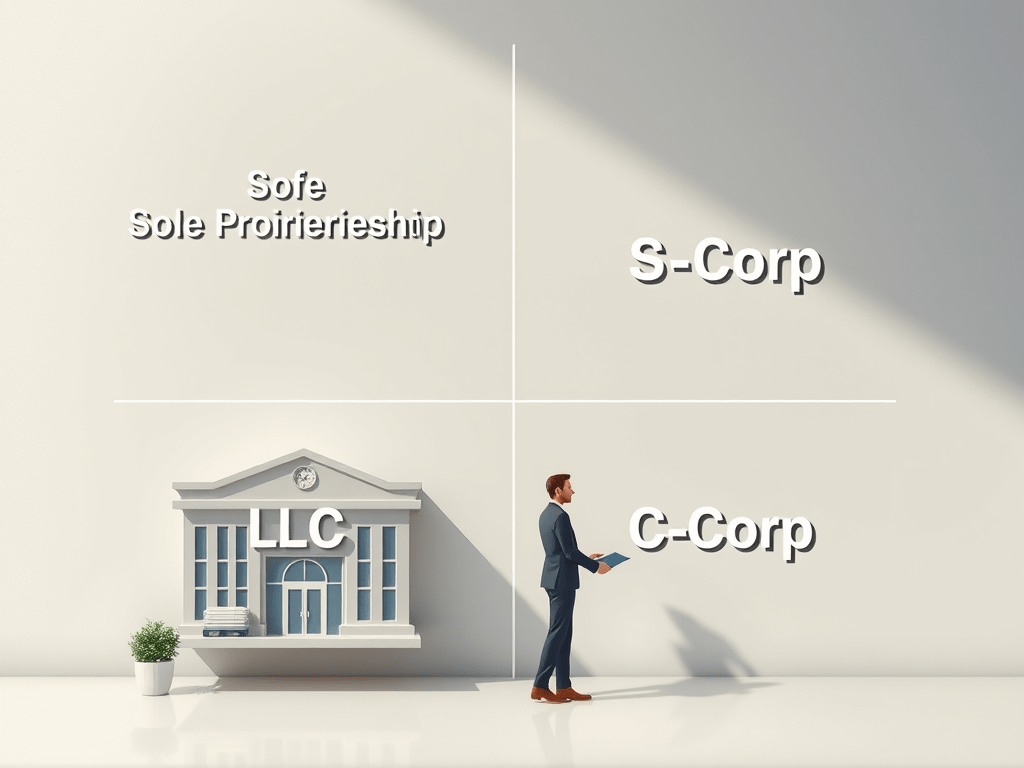
The Pros & Cons of Different Business Structures for Taxes
Choosing the right business structure is one of the most important decisions entrepreneurs make. Each structure has unique tax implications, liability considerations, and administrative requirements. Below, we break down the pros and cons of the four main business structures: Sole Proprietorship, LLC, S-Corp, and C-Corp, to help you make the best choice for your business.
1. Sole Proprietorship
A sole proprietorship is the simplest and most common business structure for solo entrepreneurs.
Pros:
- Easy and Inexpensive to Set Up – Minimal paperwork and costs.
- Pass-Through Taxation – Business income is reported on your personal tax return (Schedule C), avoiding double taxation.
- Full Control – No need to consult partners or shareholders.
Cons:
- Unlimited Personal Liability – You are personally responsible for all debts and legal issues.
- Self-Employment Taxes – Subject to 15.3% self-employment tax on all business profits.
- Limited Growth Potential – Harder to attract investors or secure business credit.
2. Limited Liability Company (LLC)
An LLC is a flexible structure that combines the simplicity of a sole proprietorship with the liability protection of a corporation.
Pros:
- Limited Liability Protection – Personal assets are generally protected from business debts.
- Tax Flexibility – Can be taxed as a sole proprietorship, partnership, or elect S-Corp taxation.
- Less Formality – Fewer corporate formalities and recordkeeping than a corporation.
Cons:
- Self-Employment Taxes (Default Taxation) – Profits are subject to self-employment tax unless electing S-Corp status.
- State Fees & Compliance – LLC fees vary by state and may be costly in some jurisdictions.
- Limited Investment Appeal – Harder to raise capital compared to a corporation.
3. S Corporation (S-Corp)
An S-Corp is a tax designation available to LLCs and corporations, offering pass-through taxation and potential self-employment tax savings.
Pros:
- Pass-Through Taxation – Profits pass through to owners’ personal tax returns, avoiding corporate income tax.
- Self-Employment Tax Savings – Owners can pay themselves a reasonable salary and take additional profits as distributions, which are not subject to self-employment tax.
- Liability Protection – Owners are shielded from business liabilities.
Cons:
- Strict Eligibility Requirements – Limited to 100 shareholders, all of whom must be U.S. citizens or residents.
- More Paperwork & Compliance – Requires annual filings, payroll for owners, and formalities like board meetings.
- Reasonable Salary Requirement – The IRS scrutinizes S-Corp owner salaries to prevent tax avoidance.
How to File for S-Corp Status:
To designate your business as an S-Corp, you must:
- Register your business as an LLC or C-Corp.
- File Form 2553 (Election by a Small Business Corporation) with the IRS within two months and 15 days after the beginning of the tax year when you want the S-Corp status to take effect. This is very important.
- Ensure all shareholders meet the IRS eligibility requirements.
- Follow state-specific filing requirements, if applicable.
4. C Corporation (C-Corp)
A C-Corp is a separate legal entity, commonly used by larger businesses or those seeking outside investment.
Pros:
- Limited Liability – Owners are not personally liable for business debts.
- Lower Corporate Tax Rate – The current federal corporate tax rate is 21%.
- Unlimited Growth Potential – Can issue unlimited stock and attract investors.
- Employee Benefits – Can offer stock options and tax-deductible employee benefits.
Cons:
- Double Taxation – Profits are taxed at the corporate level and again when distributed as dividends to shareholders.
- Complexity & Cost – Requires more paperwork, recordkeeping, and compliance with corporate formalities.
- Less Flexibility for Losses – Losses remain within the corporation and do not pass through to owners.
Startup Cost Deduction
When starting a new business, you can deduct up to $10,000 in startup costs in your first year. These costs may include:
- Market research
- Legal and professional fees
- Business licensing and permits
- Advertising and branding
- Office space setup
If your total startup costs exceed $50,000, the deduction is reduced dollar for dollar, and any remaining costs must be amortized over 15 years. This deduction can help reduce your taxable income in the crucial early stages of your business.
Which Business Structure is Right for You?
- Choose a Sole Proprietorship if you’re just starting and want a simple structure with minimal paperwork.
- Choose an LLC if you want liability protection without the complexity of a corporation.
- Choose an S-Corp if you want to save on self-employment taxes and qualify under the IRS rules.
- Choose a C-Corp if you plan to seek outside investors, scale significantly, or reinvest profits back into the business.
Final Thoughts
Selecting the right business structure depends on your business goals, tax strategy, and liability preferences. Reach out if you would like to discuss your specific situation.




 Silicon Valley Strategy & Tax
Leave a comment