Estimated Taxes: How to Avoid the Underpayment Penalty
The federal income tax is pay-as-you-go. If too little is withheld from your income during the year, the IRS expects you to make up the difference with quarterly estimated payments. Miss them and you can owe a penalty, even if you pay every dollar by April 15.
This catches many Bay Area households: employees with large RSU vests, anyone with a side business, and investors with big capital gains. California has its own version, on a different schedule.
1. Who Needs to Pay
You generally need to make estimated payments if you expect to owe at least $1,000 when you file, after subtracting withholding and refundable credits.
Common triggers:
- Self-employment or side hustle income, which has no withholding
- RSU vests and bonuses, typically withheld at a flat 22% even if you are in a higher bracket
- Capital gains, dividends and interest
- Rental income
- Unemployment benefits with no withholding
2. The Safe Harbors
You will not owe an underpayment penalty if your withholding and timely estimated payments add up to at least the smaller of:
- 90% of this year’s tax, or
- 100% of last year’s tax.
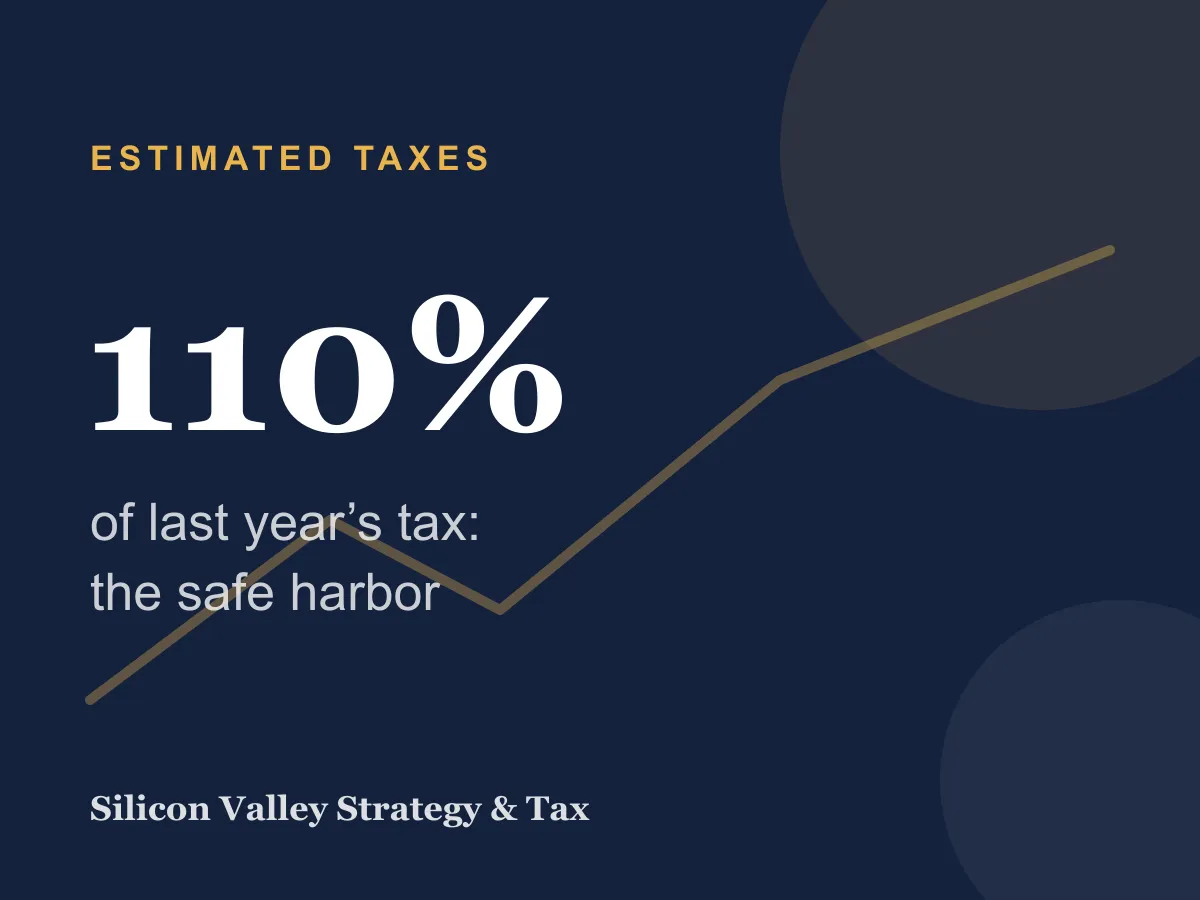
Higher-income rule: if last year’s adjusted gross income was over $150,000 ($75,000 if married filing separately), the second test becomes 110% of last year’s tax.
Tip:
The prior-year safe harbor is the simplest to use. You know last year’s tax exactly. Pay 110% of it through withholding and estimates, and no federal underpayment penalty applies, no matter how much more you earn this year. You still pay the remaining balance by April 15.
3. When Payments Are Due
For tax year 2026, the four federal payments are due:
- April 15, 2026
- June 15, 2026
- September 15, 2026
- January 15, 2027
The IRS generally expects four equal payments. Paying everything in January does not erase the penalty for the earlier quarters, because it is figured separately for each due date.
4. Withholding Counts Differently
Here is a detail a true tax expert uses. Withholding is treated as if it were paid evenly throughout the year, no matter when it actually came out of your pay. Estimated payments count only from the day you make them.
Why it matters: if you discover in November that you are short, a late estimated payment only fixes the last quarter. But raising your withholding for the final paychecks of the year, by filing a new Form W-4 with your employer, is spread back across all four quarters and can eliminate the penalty entirely.
5. If Your Income Is Uneven
If most of your income arrived late in the year, such as a December stock sale or a fourth-quarter vest, you may be able to reduce or avoid the penalty with the annualized income installment method on Form 2210. It matches the required payments to when you actually earned the income. It takes more work, but it often pays for itself.
6. California Has Its Own Rules
California’s rules look similar, with important differences.
Who must pay: generally, if you expect to owe at least $500 ($250 if married filing separately).
The schedule is not equal quarters:
- 30% due April 15
- 40% due June 15
- 0% due September 15
- 30% due January 15
Safe harbors: 90% of this year’s tax or 100% of last year’s. If last year’s California AGI was over $150,000 ($75,000 if married filing separately), use 110% of last year’s tax.
Bay Area Consideration:
If your current-year California AGI is $1,000,000 or more ($500,000 if married filing separately), the prior-year safe harbor is not available. You must pay 90% of this year’s tax. A large stock sale or liquidity event can push you over that line, so plan the payments before the sale, not after.
7. What the Penalty Actually Is
The underpayment penalty works like interest. It is charged on the amount you were short for each quarter, for the number of days it was unpaid, at a rate the IRS resets every quarter. It is figured on Form 2210.
The IRS can waive it in limited cases, such as a casualty or disaster, or if you retired after age 62 or became disabled and the shortfall was due to reasonable cause.
Final Thoughts
Underpayment penalties are among the most avoidable costs on a tax return. A quick projection in the fall, after your vests and before year-end, is usually all it takes. If your income changed this year, call us and we will work out what to pay and when.
Sources: IRS Tax Topic 306, Penalty for Underpayment of Estimated Tax; IRS Publication 505 (2026); Instructions for Form 2210; California FTB “Estimated tax payments” page.
Want a second pair of eyes on your return?
We check every return for credits and deductions like these.
Published November 11, 2026. Tax rules and dollar limits change from year to year, so confirm the figures for the year you are filing.